
The scorching Kenyan sun cast long shadows across Jacob Ochieng’s weathered hands as he traced the boundary lines of the plot he had dreamed about for decades. Every callus, every weathered crease told a story of sacrifice—of nights spent cleaning hospital floors in Nairobi, of remittance cheques carefully hoarded, of a lifetime of hopes compressed into this small patch of red-brown earth.

He remembered the day he first purchased the land near Eldoret. It wasn’t just soil and stones to him, but a canvas of possibility. Here, he would build a home for his aging parents, create a small farm that would sustain his family, and finally—finally—have something to show for the years of backbreaking work abroad.
The documents seemed pristine when he’d bought them. Stamped. Signed. Notarized. But in Kenya, paperwork can be a delicate dance pitting illusion against reality.
Months passed. Years. Each visit home revealed subtle changes. Slight encroachments. Mysterious survey markers. Whispered warnings from local officials who smiled too broadly, whose handshakes lingered just a moment too long.
When Jacob finally decided to develop the land, the nightmare began. Duplicate titles. Contested boundaries. A web of bureaucratic tentacles that seemed designed to suffocate dreams. Corrupt land registry officials who demanded bribes. Mysterious clan elders who appeared with competing claims. Legal fees that mounted like vultures circling a dying hope.
His savings—carefully accumulated over fifteen years of working as a hospital maintenance worker in London—began to hemorrhage. Lawyers. Surveyors. More lawyers. Each document, each stamp, each hearing consumed more of his hard-earned money.
The land remained—beautiful, taunting, just out of reach.
By the time the dust settled, Jacob had spent more trying to prove his ownership than the land was worth. His dream dissolved like mist under the unforgiving equatorial sun, leaving behind only the bitter taste of institutional corruption and systemic indifference.
Beyond the Allegory: The Real Crisis
While Jacob Ochieng himself may be fictional, his story represents the very real struggles faced by thousands of Kenyans every day. This composite narrative draws from documented cases across the country, distilling the common patterns of hope, exploitation, and disillusionment that characterize land ownership challenges in Kenya. Though I created Jacob to give a human face to complex systemic issues, the obstacles he encounters—duplicate titles, corrupt officials, endless legal battles, and financial ruin—are painfully authentic experiences for many citizens. These are not just stories; they are the lived reality that demands our attention and action.
The Current Landscape: A System Broken Beyond Repair?
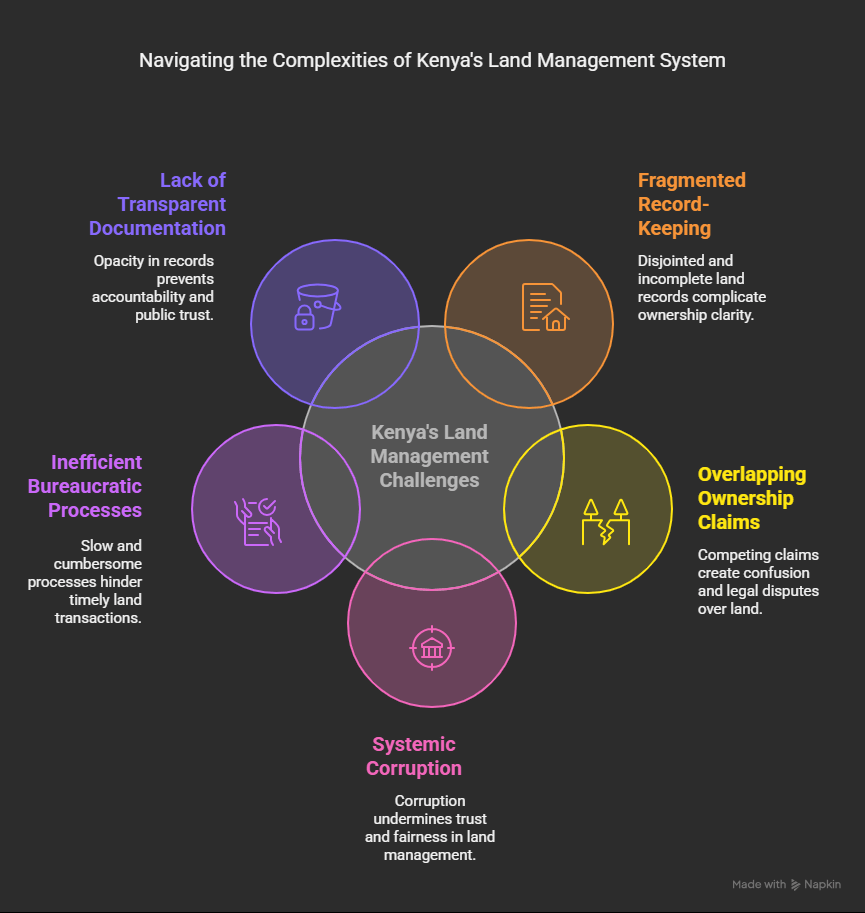
Kenya’s land management has long been a complex tapestry of challenges:
- Fragmented record-keeping
- Overlapping ownership claims
- Systemic corruption
- Inefficient bureaucratic processes
- Lack of transparent documentation
The infamous “Ardhi House Cartels” shamelessly obfuscate land records and freely engage in altering land titles, forging signatures, issuing fraudulent title deeds, and deliberately “losing” critical land records to enable illegal acquisitions.
As one anonymous source within the Ministry of Lands reported, “It is an open secret that if you want your land transaction to go smoothly, you pay the right people… Even the loss of records is often ‘arranged’ when needed for fraudulent deals”
But what if technology could be the sledgehammer that breaks through these institutional walls?
Enter the Digital Disruptors: Blockchain and AI
Emerging technologies offer more than just incremental improvements—they promise a fundamental reimagining of how land ownership can be documented, verified, and protected.
Blockchain: The Immutable Ledger of Truth
Imagine a land registry where:
- Every transaction is permanently recorded
- Ownership cannot be altered without comprehensive verification
- Historical ownership trails are transparent and unalterable
- Fraud becomes exponentially more difficult

Blockchain doesn’t just digitize records—it creates a trust architecture that makes manipulation virtually impossible. As a decentralized, distributed ledger system, blockchain offers unique features that make it particularly well-suited for land title registration and management. The technology works by grouping digital transactions into cryptographically protected blocks that are validated by the network, timestamped, and added to a chain in chronological order.
Artificial Intelligence: The Intelligent Investigator
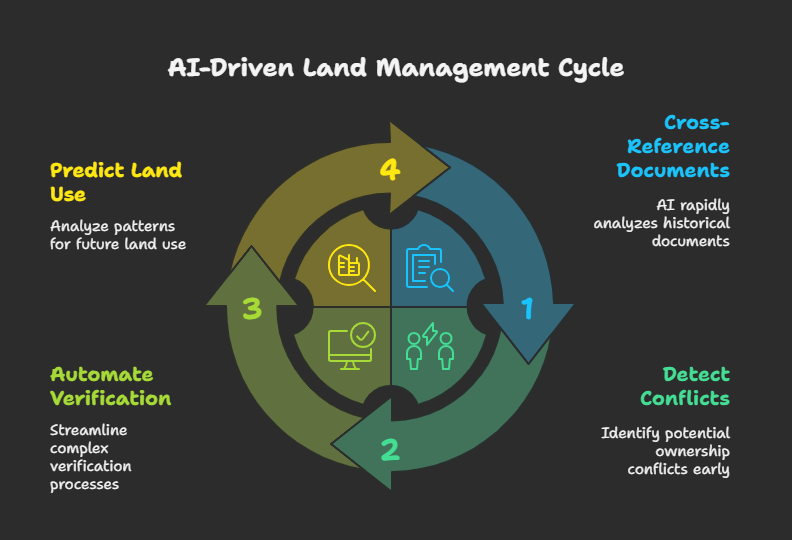
AI can transform land management by:
- Rapidly cross-referencing historical documents
- Detecting potential ownership conflicts before they escalate
- Automating complex verification processes
- Providing predictive analysis of land use and ownership patterns
Beyond Technology: A Vision of Empowerment
This isn’t about replacing human judgment, but augmenting it. By creating systems that are transparent, efficient, and fundamentally fair, we can restore dignity to the process of land ownership.
For Jacob Ochieng, and thousands like him, technology represents more than innovation. It’s hope—encoded, encrypted, and finally, made real.
By 2019, Kenya ranked 134th globally in ease of property registration, with the process typically requiring 43 days and 10 procedures—and this assumes optimal conditions without the well-documented institutional challenges. These statistics highlight significant inefficiencies in the current system and underscore the potential value of innovative solutions combining blockchain technology and artificial intelligence.
Strategic Innovation Potential
Kenya has long recognized blockchain technology’s transformative possibilities, particularly for land transactions. In 2018, the national government established a dedicated task force to evaluate this emerging technology. Their findings were definitive: they strongly recommended implementing blockchain-powered solutions as a direct strategy to address the systemic corruption issues plaguing the current system.
Fraud Prevention Advantages of Blockchain-Based Land Registry
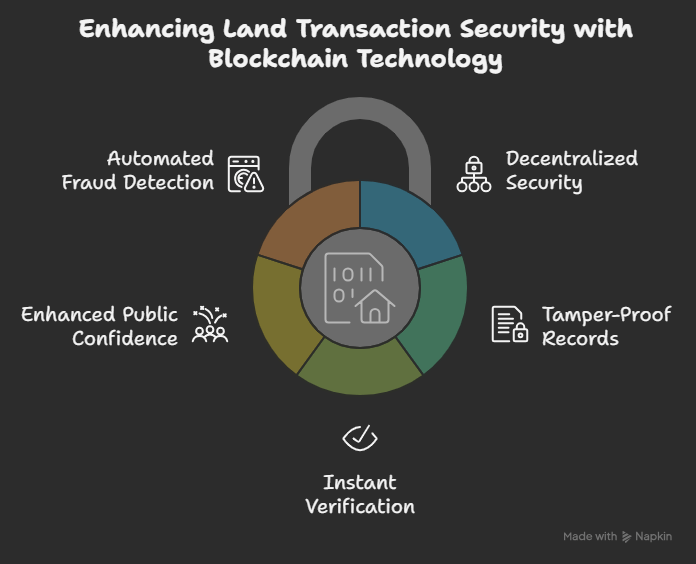
A blockchain-based registry in Kenya would strengthen land transaction security through several key mechanisms:
Decentralized security – By distributing record-keeping across multiple points, blockchain eliminates the vulnerability of having a single point of failure or corruption
Tamper-proof records – Once verified and entered, records cannot be backdated or altered, preventing the removal of important encumbrances
Instant verification capabilities – Banks and buyers can immediately confirm title deed legitimacy without extensive manual checks, significantly reducing due diligence costs
Enhanced public confidence – The transparent and secure nature of blockchain builds greater trust among investors and citizens over time
Automated fraud detection – Smart contracts can automatically identify suspicious activities, such as attempts to register duplicate titles for the same land parcel
Estonia: Proof of concept
Estonia exemplifies how a relatively small nation can pioneer digital governance at a global scale. The country has established itself as a genuine digital government leader, implementing a fully electronic, publicly accessible land registry that sets international standards.
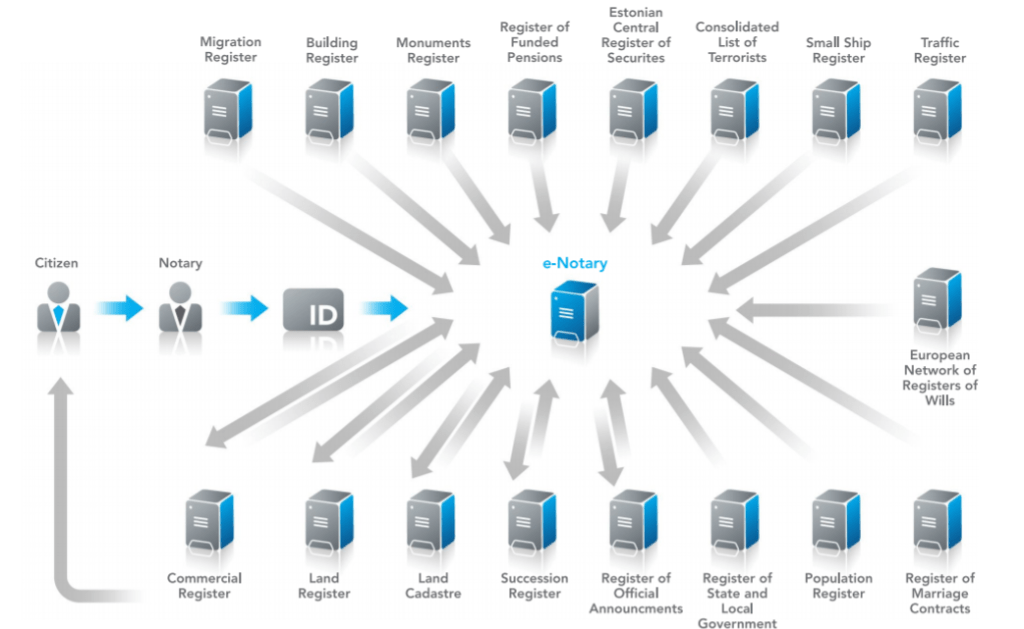
Their system employs a sophisticated hash-linked time-stamping blockchain protocol that safeguards the national immovable property database with remarkable effectiveness. This implementation delivers multiple advantages:
- Advanced security features – The paperless system links all notaries nationwide through a centralized network with tamper-evident protections.
- Cryptographic verification – Any unauthorized modification attempts trigger immediate detection when cryptographic hashes fail to match.
- Corruption-resistant architecture – The system’s design makes it virtually impervious to manipulation, even by well-positioned insiders.
Estonia’s success demonstrates how technology can fundamentally transform property management and eliminate corruption in land conveyancing. Their achievement serves as compelling evidence that with sufficient commitment, political will, and proper support, Kenya could implement a similar system tailored to its unique context and requirements.
African Parallels and Shared Challenges
Ghana: A Regional Case Study
Ghana and Kenya share significant similarities beyond their status as developing African nations. Like Kenya, Ghana has struggled with widespread corruption in its complex land tenure system, which eventually catalyzed reform initiatives.

Ghana’s approach to addressing these challenges included:
- Development of the Digital Land Information System (LIS), initially known as GHANA LIS
- Evolution into the more comprehensive Ghana Enterprise Land Information System (GELIS), which serves as a comparable counterpart to Kenya’s Ardhisasa platform
- Exploration of blockchain technology applications for land administration
Despite these technological advancements, Ghana’s reform efforts have encountered obstacles similar to Kenya’s. Progress has been impeded by bureaucratic complexities and political resistance, highlighting an important lesson: technological solutions alone cannot resolve deeply entrenched land governance issues.
Despite attempting to create a foolproof system like the one in Estonia, manual processes persist and coexist with digital ones, and with all the inefficiencies that come with them.
The Ghanaian experience reinforces that successful land reform requires addressing broader political and socio-economic barriers alongside technological innovation.
Rwanda: A Hub of Innovation
The Republic of Rwanda stands as Africa’s equivalent to Estonia in terms of digital transformation and governance. Through its pioneering Land Tenure Regularization program implemented between 2008 and 2013, this small nation emerged as a regional leader by systematically registering and titling over 10 million land parcels, extending ownership rights to historically marginalized groups, including women.

Rwanda’s true breakthrough came with the comprehensive digitization of land records. By 2023, all 10 million titles had been converted to digital format, with 866,000 downloaded at no cost, in stark contrast to the previous paper-based system. This digital transition dramatically reduced opportunities for fraud.
Further advancing its land management systems, Rwanda established a partnership between Medici Land Governance (MLG), the Rwanda Land Management and Use Authority (RLMUA), and the Rwanda Information Society Authority (RISA) to develop the blockchain-powered “Ubutaka App.” This innovative platform securely collects landowner data—including fingerprints, signatures, and legal approvals—creating an immutable record of authorizations that prevents double selling, impersonation, and signature forgery.
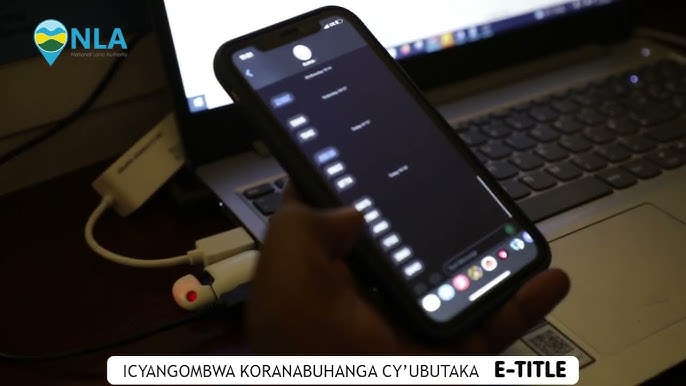
As one of the few African nations with a publicly accessible land information portal, Rwanda’s achievements highlight what’s possible with proper systems and political commitment. Their progress demonstrates how technological innovation can eliminate bureaucratic inefficiencies and establish a secure, transparent land registration and transfer system—setting a standard that challenges other nations, including Kenya, to modernize their approaches.
Conclusion: The Path Forward
Kenya stands at a crossroads. The heartbreaking story of Jacob Ochieng—whose dreams were crushed under the weight of a dysfunctional land management system—represents thousands of similar tragedies playing out across the nation. But the future need not mirror the past.
The compelling examples of Estonia, Rwanda, and the cautionary lessons from Ghana offer Kenya a blueprint for transformation. These case studies demonstrate that technological solutions like blockchain and AI aren’t mere theoretical concepts but practical, implementable frameworks that can fundamentally reshape land ownership security.
However, technology alone is insufficient. Rwanda’s success stems not just from digital innovation but from political will and comprehensive reform. The lesson is clear: blockchain and AI must be coupled with institutional transformation, legal reforms, and genuine commitment to transparency at all levels of governance.
For Kenya to truly revolutionize its land management system, it must:
- Embrace blockchain’s immutability to create tamper-proof land records
- Deploy AI to detect fraudulent patterns and prevent corruption before it occurs
- Reform legal frameworks to support digital transformation
- Invest in public education to ensure widespread adoption and understanding
- Establish oversight mechanisms that hold officials accountable
The technology exists. The successful models exist. What remains is the courage to dismantle entrenched systems of corruption and replace them with frameworks built on transparency, accessibility, and trust.

For the Jacob Ochiengs of Kenya—those who have lost their savings, their dignity, and their dreams to a broken system—this transformation cannot come soon enough. Their stories demand not just sympathy but action. In the digital revolution of land management lies the potential to restore both property rights and human dignity, turning bitter tales of corruption into narratives of empowerment and justice.
Happy Week!


 Bytes of Justice
Leave a comment