
They are coming for your jobs!
The Digital Divide: When Lawyers Meet AI
Imagine a Tier 1 law office in 2024 where a senior partner spends over an hour reviewing a contract by hand. His accuracy rate of 86% reflects decades of expertise—countless hours spent analyzing similar documents, understanding nuances, and catching subtle legal implications. Meanwhile, an AI system completes the same review in just 26 seconds with 94% accuracy, echoing the 2018 LawGeex study that pitted the machine against 20 seasoned lawyers.
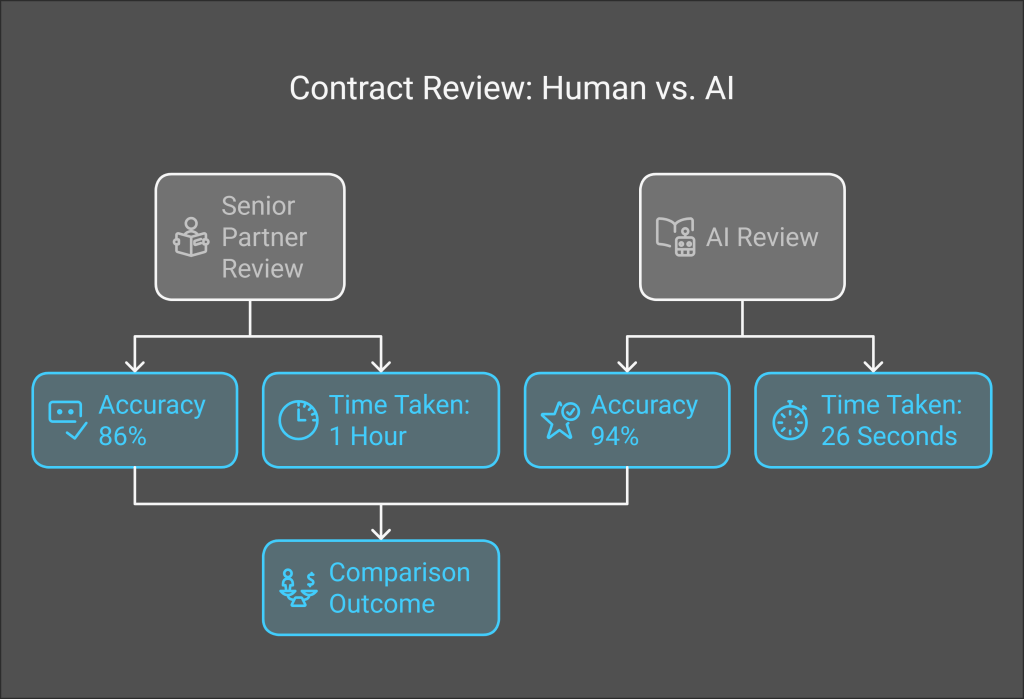
Welcome to the paradox of algorithm aversion in law—where the very professionals trained to trust evidence and follow logical reasoning find themselves resisting tools that demonstrably improve their work.
The Psychology of Resistance
While lawyers are trained to evaluate evidence objectively and follow logical reasoning, they demonstrate a peculiar resistance to algorithmic assistance. Research by Dr. Berkeley Dietvorst shows that even when algorithms outperform humans, people still favor human judgment—a paradox especially evident in the legal field.
A History of Hesitation
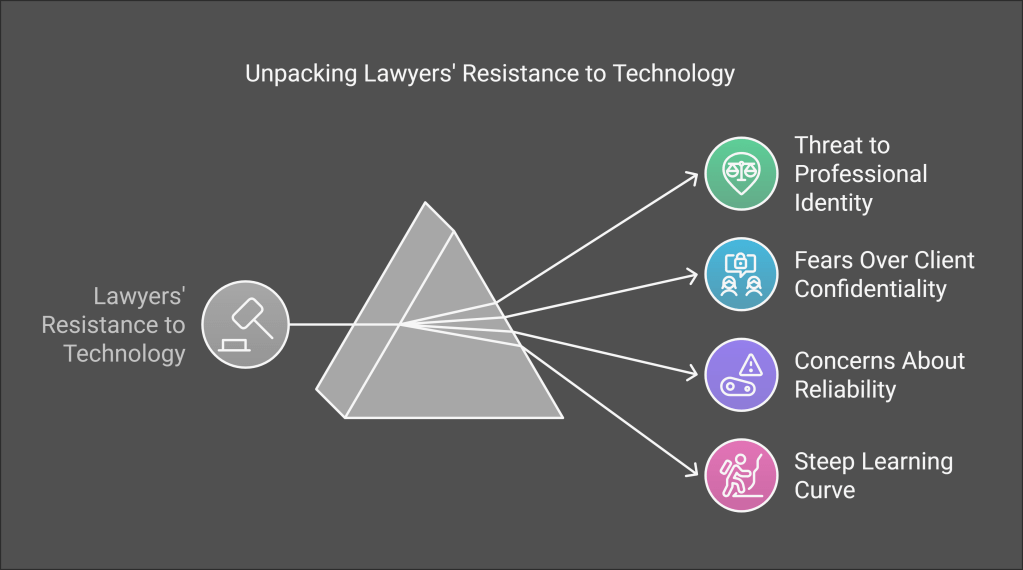
Historically, lawyers have been slow to embrace technology. A 2019 study comparative study revealed a startling insight: among professionals including pharmacists, physicians, and certified public accountants, lawyers demonstrated the least experience with computers. More telling was their characterization of technology as “depersonalizing,” “formal,” and “difficult”—words that reveal deep-seated psychological barriers rather than mere technical challenges. Resistance stems from deep-seated concerns: a threat to professional identity, fears over client confidentiality, and practical worries about reliability and the steep learning curve.
The Stakes
Yet as the legal profession grapples with these concerns, AI capabilities continue to advance at a breathtaking pace. OpenAI CEO Sam Altman’s recent claim about their Deep Research model being able to “perform a single-digit percentage of all economically valuable tasks” isn’t just corporate hyperbole—it’s a wake-up call to a profession standing at a technological crossroads.
The most forward-thinking law firms are already discovering that the question isn’t whether to adopt AI, but how to integrate it effectively. As Justice Holmes once observed, “The law must be stable, but it must not stand still.” Today, that wisdom applies not just to legal principles, but to legal practice itself.
The challenge facing lawyers isn’t whether to resist or embrace AI—it’s how to maintain the human essence of legal practice while leveraging technological capabilities that can no longer be ignored. The future of law lies not in choosing between human expertise and artificial intelligence, but in learning to combine them effectively.
Ghosts in the Machine: Unpacking Algorithm Aversion
Have you ever driven the same route to work for years, knowing there might be a faster way but sticking to your familiar path anyway? Or kept using an old phone even when a newer model could make your life easier? If so, you’ve experienced the same psychological forces that make lawyers resistant to AI tools.
The Power of Habit and Fear
Our brains naturally cling to the familiar—a fact highlighted by Daniel Kahneman’s research on decision-making. For lawyers, this means relying on trusted methods even when superior alternatives exist, feeling uneasy about ceding control to a machine, and selectively focusing on evidence that confirms their skepticism.
The Technology Trust Paradox
Here’s where things get interesting. Our relationship with technology isn’t simple—it’s full of contradictions. Sometimes we trust technology too much (like blindly following GPS into a dead end), while other times we distrust it without reason (like refusing to use online banking despite its proven security).
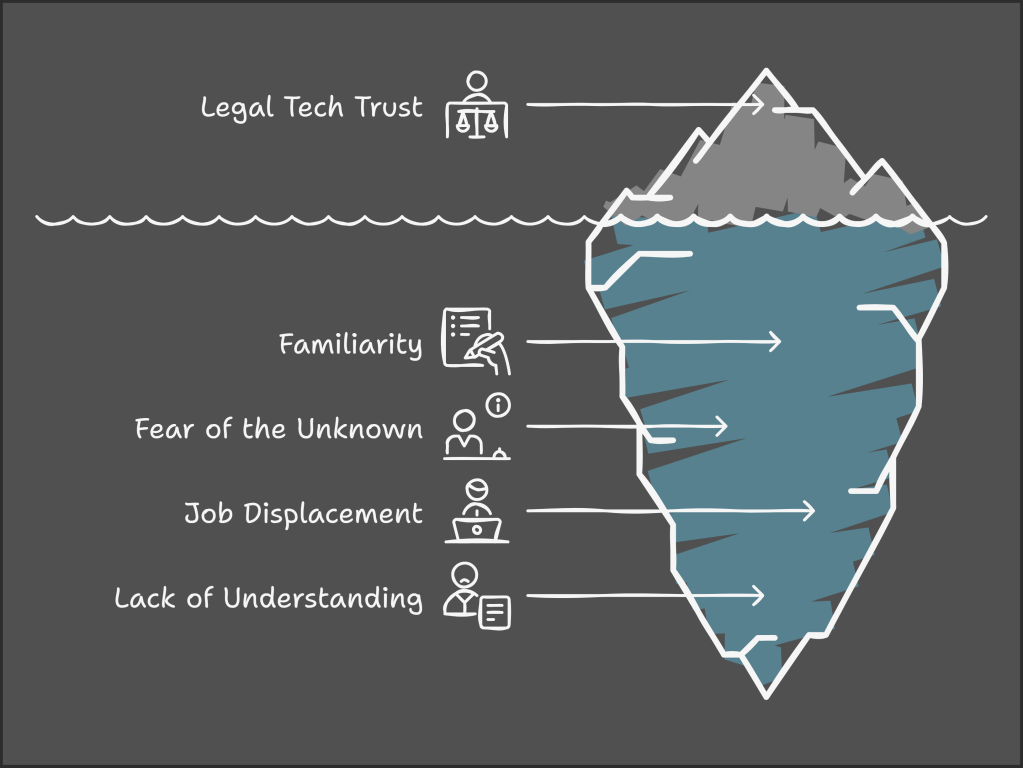
In the legal profession, this plays out in fascinating ways:
- A lawyer might readily trust a basic spell-checker but resist an AI tool that can spot complex legal issues
- They might embrace electronic filing systems but balk at AI-powered legal research
- They could trust cloud storage for sensitive documents but resist AI document analysis
The Path Forward
Moving forward, successful law firms will acknowledge these natural resistances and develop strategies to work with them. Just as GPS technology eventually became an indispensable complement to driving, AI can enhance legal expertise rather than replace it.
The Fear Factor: Decoding Professional Anxiety
Imagine spending decades mastering the intricate dance of legal reasoning, only to watch an AI system analyze cases in seconds. For many lawyers, this isn’t just about efficiency—it’s about identity. Like a master craftsman watching an assembly line replicate their handiwork, the emotional impact runs deeper than mere resistance to change.
From Oracle to Operator
“The wise counsel becomes the technology manager.” This transformation, highlighted by legal futurist Richard Susskind, strikes at the heart of professional identity. Think of a lawyer who spent years developing an almost intuitive sense for case outcomes, now facing AI systems that can predict results with freakish statistical precision. It’s not just about who can do the job better—it’s about what it means to be a lawyer in the first place.
The Judgment Paradox
Consider a veteran judge who has spent decades reading subtle cues in a courtroom—body language, tone of voice, the weight of context in human stories. Now imagine telling them that an algorithm might make more consistent decisions. This isn’t just about resistance to technology; it’s about preserving the human element in a profession built on human judgment.
The anxiety runs deeper:
The Race Against the Machine
- While some firms embrace AI tools for high-volume tasks, others hesitate
- Those who wait feel the ground shifting beneath their feet
- The fear isn’t just about being replaced—it’s about becoming obsolete while still in practice
The Value Proposition Crisis
- When AI can accurate draft legal documents in minutes, how do you justify billing hours?
- Clients increasingly question traditional cost structures
- The very meaning of “legal work” is being redefined
Finding New Ground
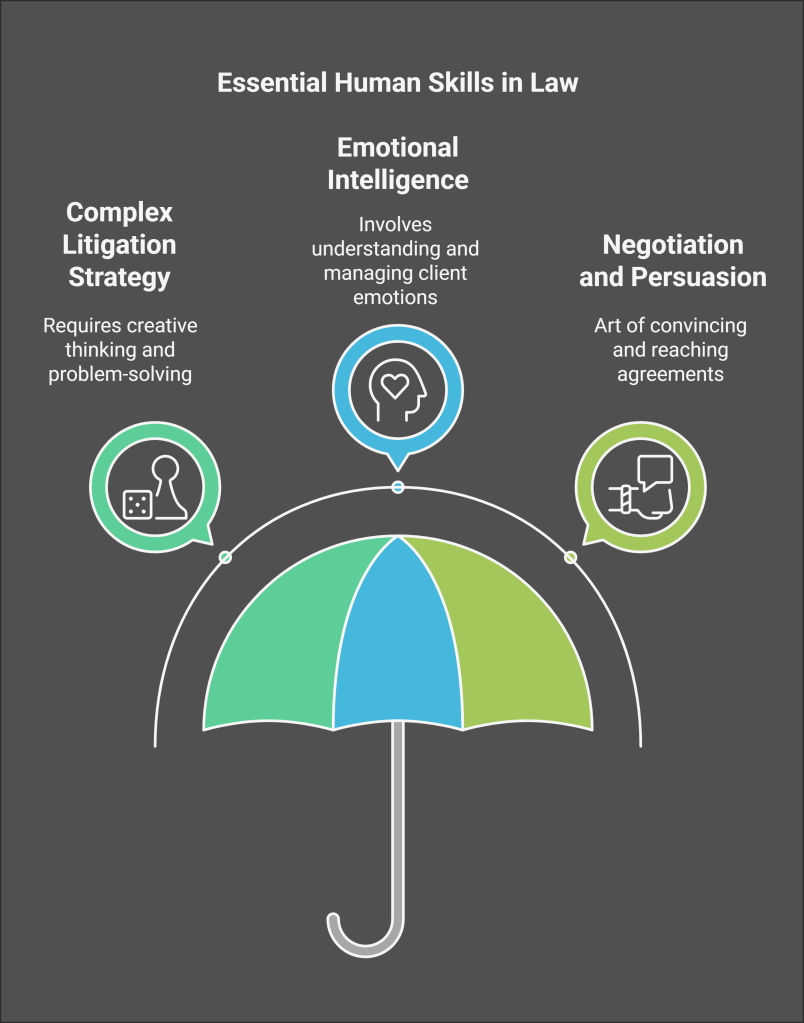
Yet in this technological upheaval, new opportunities emerge. Like Uber and Taxis, and skilled navigators who remained essential even after GPS became ubiquitous, lawyers are finding their irreplaceable human elements:
- Complex litigation strategy that requires creative thinking
- Emotional intelligence in client counseling
- The art of negotiation and persuasion
The challenge isn’t about competing with AI—it’s about evolving alongside it. AI will excel at what it is good at, but human insight, intuition, and empathy cannot be replaced, even by the famed AGI.
The Path Forward
The transformation of legal practice isn’t just about learning new technologies—it’s about redefining professional worth. The most successful lawyers aren’t those who resist change or surrender to it, but those who find ways to blend human insight with technological capability.
As David Autor’s research suggests, automation often complements rather than replaces human expertise. The future lawyer might spend less time on document review but more time on strategic thinking, client relationships, and complex problem-solving—areas where human judgment remains irreplaceable.
Numbers Don’t Lie, But Do Lawyers Trust Them?
While AI offers the potential for increased efficiency and accuracy in tasks like document review and legal research (as discussed in articles like Artificial Intelligence vs. Human in the Legal Profession – LRZ and Artificial intelligence taking growing role in legal sector – Pinsent Masons), many lawyers are hesitant to fully embrace it.
This reluctance stems from concerns about job security, the perceived erosion of traditional legal skills, and a questioning of their professional identity in a tech-driven world. Will their expertise become obsolete? Will robots replace them in the courtroom?
The reality is more nuanced. AI excels at specific, well-defined tasks, like analyzing contracts or sifting through vast legal databases. However, it’s the human lawyer who provides the crucial elements of legal practice: creative legal strategy, negotiation and conflict resolution, client interaction, and ethical judgment. These skills, requiring emotional intelligence and an understanding of human dynamics, remain firmly in the human domain.
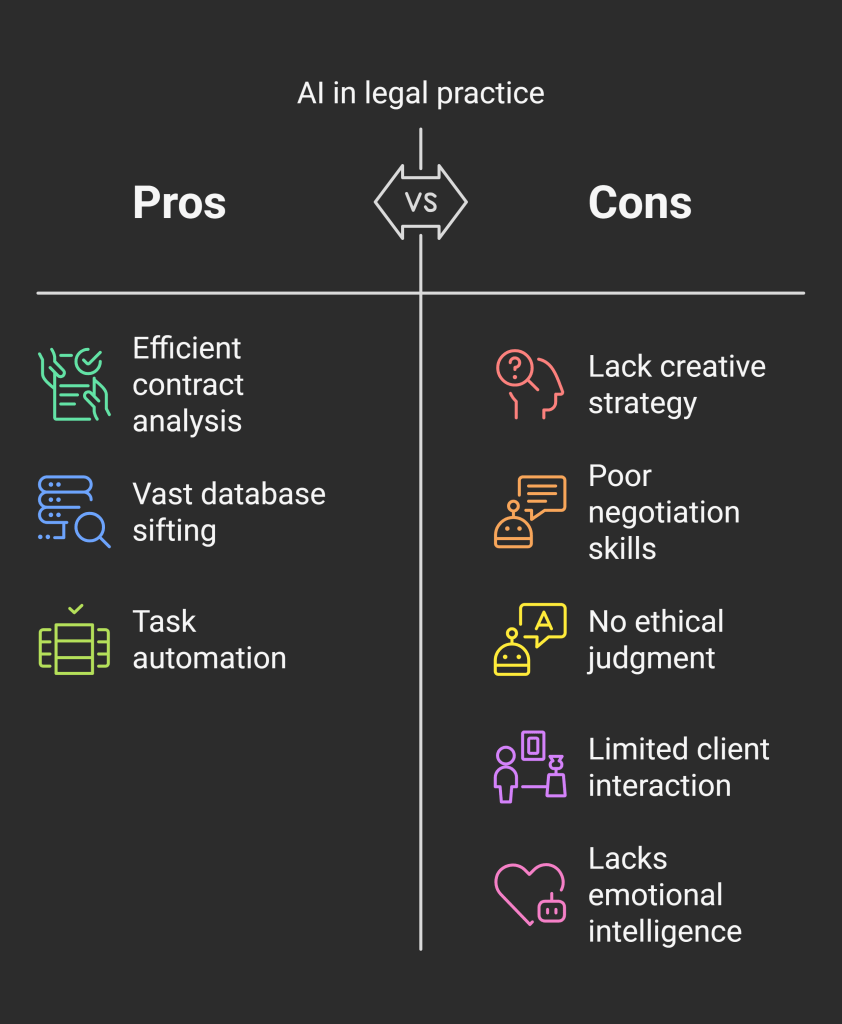
As explored in pieces like AI for Lawyers: Can AI Robots Defend a Human in Court? – Maruti Techlabs, the future of law isn’t about robots versus lawyers; it’s about robots and lawyers collaborating. Lawyers who adapt and integrate AI into their practice, focusing on the uniquely human aspects of their profession, will be the ones who thrive in the evolving legal landscape.
Building Bridges: Strategies for AI Acceptance
Imagine a world where legal professionals are empowered to focus on the most strategic and impactful aspects of their work, leaving behind the tedious and time-consuming tasks that often bog them down. This isn’t a futuristic fantasy; it’s the promise of AI in the legal field. By embracing these powerful tools, lawyers can reclaim valuable time, reduce errors, and ultimately deliver better outcomes for their clients.
Think of the countless hours spent on document review, legal research, or contract analysis – time that could be dedicated to building client relationships, crafting innovative legal strategies, and ensuring access to justice for all. This is the potential that AI unlocks, a potential that benefits not only lawyers themselves, but the entire legal system.
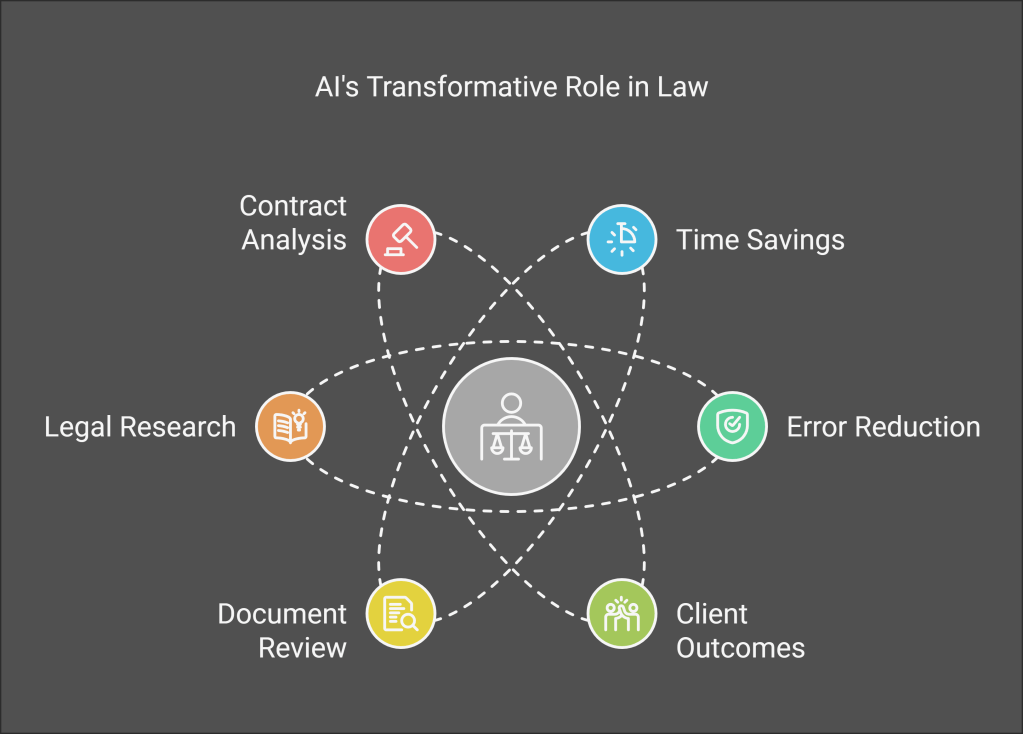
Now, I understand that change can be daunting, especially in a profession steeped in tradition. The idea of integrating AI into legal practice might raise concerns about job security or the erosion of hard-earned skills. But consider this: AI isn’t about replacing lawyers; it’s about augmenting their abilities. It’s about providing them with the tools they need to be more efficient, more effective, and more impactful.
Just as technology has transformed countless other industries, it’s poised to revolutionize the legal field, offering lawyers the opportunity to focus on what truly matters: serving their clients with expertise, empathy, and a deep understanding of the law.
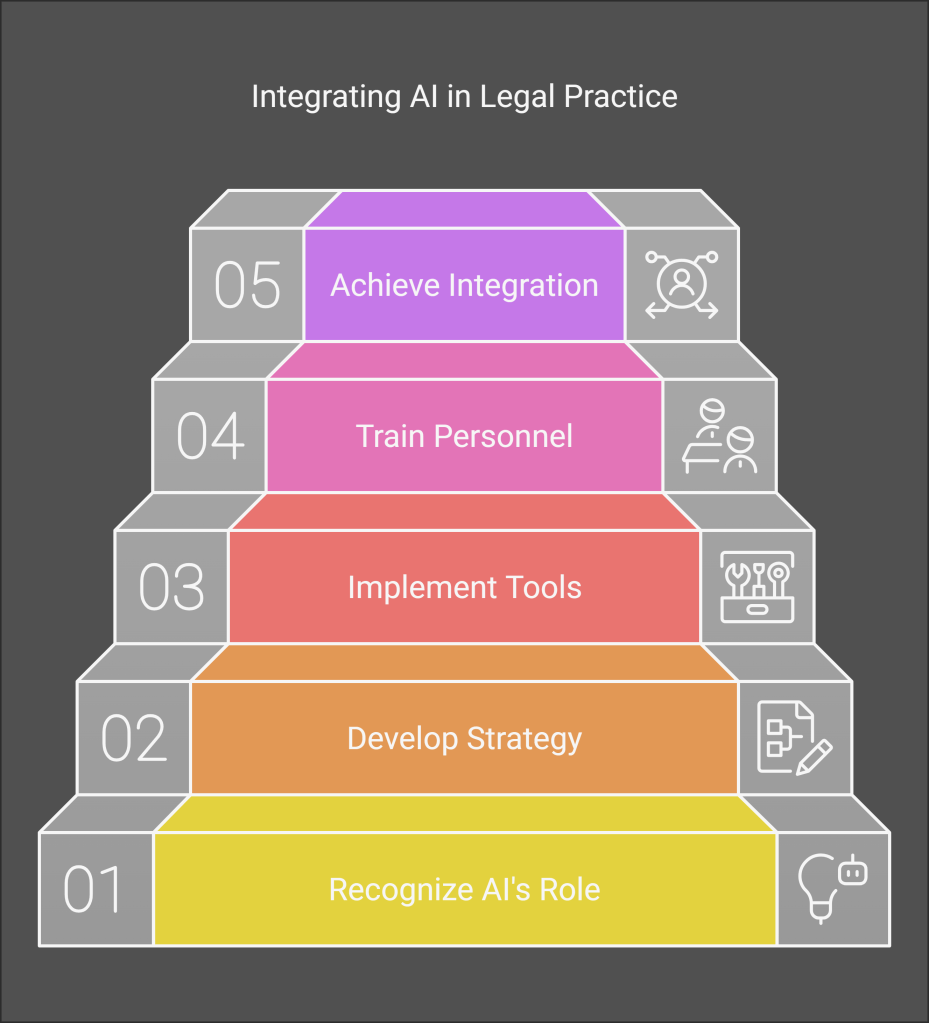
The key to successful AI integration lies in a strategic and thoughtful approach. It’s about identifying specific needs within your practice, exploring the available AI solutions, and developing a plan for implementation that addresses both the technical and human aspects of this transformative technology.
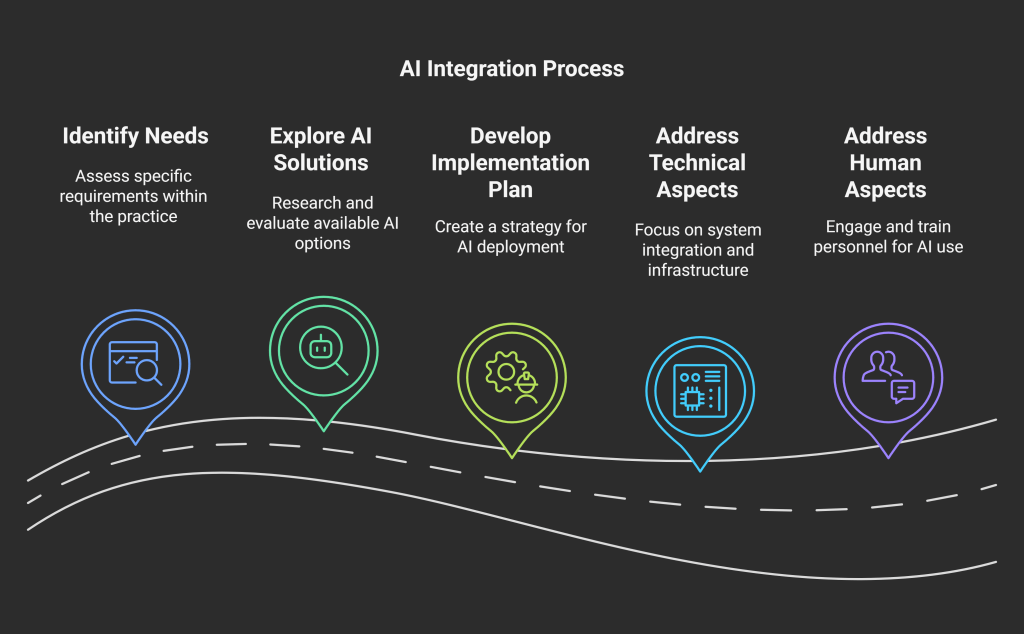
This includes providing comprehensive training for lawyers and staff, fostering a culture of collaboration between humans and AI, and addressing any ethical considerations that may arise.
Resources like The Future of Law: Robots, Lawyers, and the New Legal Landscape by Richard Susskind can provide valuable insights into this evolving landscape. By embracing AI as a partner, not a competitor, lawyers can unlock new levels of efficiency, accuracy, and client satisfaction.
Final Thoughts
The legal profession stands at a crossroads. We can cling to outdated methods and risk being left behind, or we can embrace the power of AI and shape a future where technology and human expertise work hand-in-hand to achieve justice. The choice is ours. Let’s choose progress, let’s choose innovation, and let’s choose a future where lawyers are empowered to make a real difference in the world.
Happy Week!


 Bytes of Justice
Leave a comment